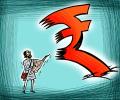
However, if the rupee depreciates much, the economy in dollar terms would be that much smaller.

To enable widen the fiscal deficit beyond the permissible limit under the present legislation, the government may have to propose amendment to the FRBM Act in the Finance Bill.

The decline is attributed to lower salary growth and a rise in households' financial liabilities.
The Centre is staring at a combined shortfall of up to Rs 1 trillion in excise and Customs revenues in the current financial year (FY23) compared to the Budget estimates (BE), mainly because of duty cuts on edible oil and petroleum products. The government set a target of Rs 3.35 trillion for excise and Rs 2.13 trillion for Customs mop-up for FY23 while presenting the Budget in February. "As excise duty collection is mainly driven by diesel volumes, we might see a clear gap in the level budgeted for FY23, following the reduction in cesses on petrol and diesel in May. We are expecting somewhere between Rs 80,000 crore and Rs 1 trillion dip in excise and customs duty collections," a senior government official told Business Standard.

'Raj saheb and I are trying to fill the backlog of the last ten years.'
Post office savings deposit, recurring deposit accounts and the senior citizen savings scheme account have shown the highest growth in the current financial year.

Economists have said if a stimulus is needed it should be different from what was provided in 2008-09, when the economy faced the ripple effects of a global meltdown following the Lehman Brothers collapse.

Significant portion of the funds used to fuel urban demand have become illegal and inoperative.

While the farmers are not getting remunerative prices for their produce, at the same time they are forced to pay high prices for items they consume.

India's dependence on imported crude oil to meet domestic demand has been a matter of concern for years. Delivering the inaugural address at the global energy summit - Urja Sangam - in 2015, Prime Minister Narendra Modi had called for enhancing domestic oil and gas production to cut the import burden. He aimed at lowering it by at least 10 per cent by 2022 - to coincide with the platinum jubilee of India's independence. But this target is far from being achieved and the country's import reliance has only risen.

Depreciating the rupee against the dollar to boost economic growth has fiscal constraints and monetary limitations

The government managed to raise revenues by sending notices to high net individuals to did not file I-T returns last year.
With India's imports exceeding exports, weak rupee does more harm than good. Analysts, however, say that rupee depriciation is positive for export-oriented sectors such as IT services, pharmaceuticals, textiles and automobiles
Some say the MPC will raise the rate, while others are of the view that there is already de facto interest rate tightening through rising bond yields, which might prompt the central bank to go for a pause.

In the past 12 months, such earnings have grown in double digits in Europe, the US, Japan and South Korea.

If the government cuts wasteful expenditure as it is trying now, the deficit would at most fall to 8 per cent, not less than that.

After the government sought Parliament's nod for a second batch of supplementary demand for grants that will cause a hit of Rs 2.99 trillion to the exchequer, doubts suddenly arose about the government's ability to meet the Budget projections of reining in its fiscal deficit at 6.8 per cent of gross domestic product (GDP), or Rs 15.06 trillion, for the current financial year. Till now, many were of the opinion that the government would succeed in checking the deficit at a much lower figure than what was given in the Budget Estimates (BE). The government had sought Parliament's approval to spend Rs 3.74 trillion extra, but Rs 74,517.01 crore will be matched by equal savings on other heads.

As the liquidity crunch reaches crisis levels and getting tax refunds remain a big headache, exporters saw orders fall by 15 per cent till October.

Onions had the highest inflation rate among all major commodities.
By no means do economists see the Reserve Bank of India stop at just a 25-bp cut. Some of the economists such as Soumyakanti Ghosh of State Bank of India are of the firm view that rates have room to fall by a total of 75 bps in the current financial year, starting with 25 bps in the August 7 policy.

Costlier vegetables and eggs pushed up retail inflation to a nearly six-and-a-half year high of 7.61 per cent in October, keeping it significantly above the comfort zone of the Reserve Bank.

Home Minister Rajnath Singh said that the decision could cost the government roughly Rs 15,000 crore.

The services sector, which plays the biggest role in shaping the economy, is facing loads of issues currently. The largest segments, financial and real estate, are struggling to cope with bad debts and low demand for houses.
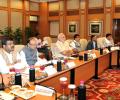
The meeting will focus on how to make the crisis an opportunity for India.

The combined share of customs and excise duties, service tax, and value-added tax in India's gross domestic product reached an all-time high of 10.5%.

The gap between expenditure and receipts totalled Rs 3.98 crore (Rs 39 million) over the April 1-August 31 period against the Rs 5.31 lakh crore(Rs 5.31 trillion) pegged in the Budget for 2014-15.

This analysis is based on the quarterly earnings for 724 companies.

The BJP is beating the development drum this time more loudly to overcome many other hurdles besides anti-incumbency. While the party is claiming it is looking for a much bigger victory than in 2017, BJP observers are not too sure about it, reports Shishir Prashant.

In five years, per-employee revenue for IT companies grew at 9 per cent each year.

'A broad-based revival of private sector investment was likely in 2018-19 after businesses had successfully made the switch to the GST.'
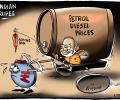
Oil sank to the lowest level in a month after shedding all of its gains from the US-Iran clash as traders waited to see whether any further hostilities will disrupt exports from the East Asia.

Higher interest rates in the US do not necessarily coincide with capital outflows.
The Union Budget 2011-2012 is likely to be more beneficial for the special and underdeveloped states, including J&K, Himachal Pradesh and Bihar, rating agency Fitch said on Wednesday.

If receipts from disinvestment, tax buoyancy and black money scheme offset shortfall in spectrum sale, higher expenditure due to pay commission's recommendations and capital expenditure, then the government would be able to meet the target of controlling fiscal deficit at 3.5 per cent of GDP this financial year.

India will be hoping to put up an improved bowling show with their front line pacers Bhuvneshwar Kumar and Jasprit Bumrah back in action for the third ODI

Sluggish infrastructure sector growth would also have impact on IIP as these segments account for about 41 per cent of the total factory output.

A dominant India posted a massive 649 for nine before their bowlers chipped away at the wickets to leave West Indies reeling on 94 for six at stumps on Day 2 of the first Test in Rajkot.

The Supreme Court on Tuesday stayed the breach of privilege motion notice issued against author Shobhaa De by Maharashtra assembly speaker for her tweets on the state government's decision to make it mandatory for multiplexes to screen Marathi movies during prime time.

Images from the first ODI between India and the West Indies in Guwahati.

World trade has been growing slower than world GDP since 2012.
